Petrol Price in Pakistan Today, 04 August 2026 Update
No Comments
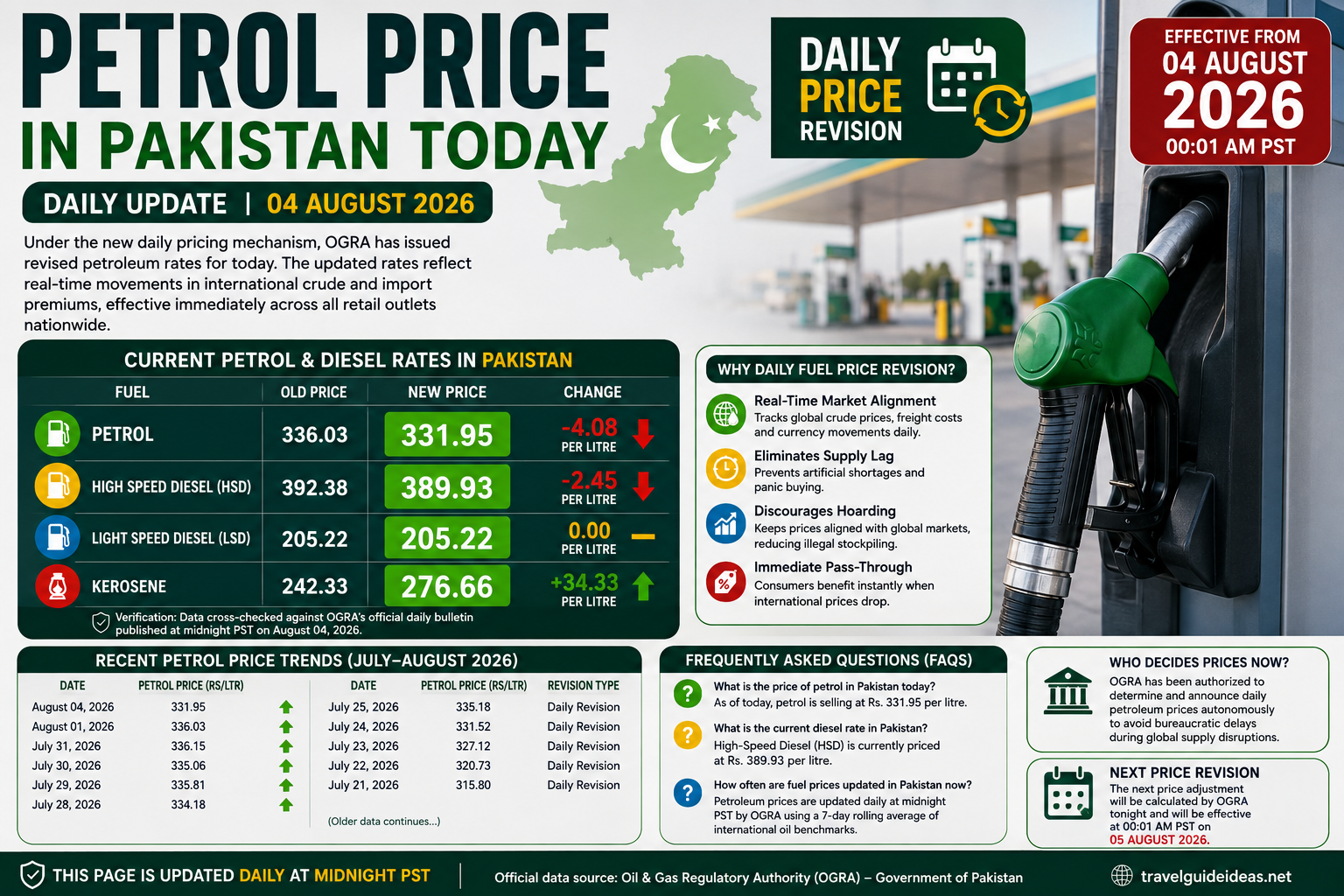
Pakistan has officially entered a daily petroleum pricing system, with the Oil and Gas Regulatory Authority (OGRA) now announcing fuel prices every midnight. Under today’s notification, both Petrol and High-Speed Diesel (HSD) have become cheaper, offering some relief to motorists and transport businesses.
According to the latest official update, Petrol has decreased by Rs. 4.08 per litre, while High-Speed Diesel (HSD) has been reduced by Rs. 2.45 per litre. The revised prices are effective immediately across all fuel stations nationwide.
Latest Petrol Price in Pakistan Today
| Fuel Type | Previous Price | New Price | Change |
|---|---|---|---|
| Petrol | Rs. 336.03 | Rs. 331.95 | ▼ Rs. 4.08 |
| High-Speed Diesel (HSD) | Rs. 392.38 | Rs. 389.93 | ▼ Rs. 2.45 |
| Light Diesel Oil (LDO) | Rs. 205.22 | Rs. 205.22 | No Change |
| Kerosene Oil | Rs. 242.33 | Rs. 276.66 | ▲ Rs. 34.33 |
Effective Date: 04 August 2026
Today’s Fuel Price Highlights
- Petrol reduced by Rs. 4.08 per litre
- High-Speed Diesel reduced by Rs. 2.45 per litre
- Light Diesel Oil remains unchanged
- Kerosene price increased by Rs. 34.33 per litre
- New prices effective immediately across Pakistan
Official OGRA Daily Fuel Price Notification
The latest petroleum prices have been published by the Oil and Gas Regulatory Authority (OGRA) under Pakistan’s new daily fuel pricing mechanism.
Unlike the previous weekly or fortnightly system, fuel prices are now calculated and updated every day based on international market conditions, ensuring local pump prices closely reflect changes in global crude oil markets.
The prices are determined using:
- International crude oil prices
- Import premiums
- Freight costs
- USD to PKR exchange rate
- Petroleum levy and taxes
- Distribution margins
Why Are Petrol Prices Changing Every Day?
The Government of Pakistan introduced a daily fuel pricing mechanism to improve market transparency and respond more quickly to global oil price movements.
The new system offers several advantages:
Faster Market Response
Domestic fuel prices now adjust almost immediately when international crude prices increase or decrease.
Reduced Fuel Shortages
Daily revisions help discourage panic buying and artificial shortages before expected price hikes.
Better Price Transparency
Consumers pay rates that more accurately reflect international oil market conditions.
Improved Supply Management
Oil marketing companies can manage inventories more efficiently under the daily pricing model.
Impact of Today’s Price Reduction
Today’s reduction in petrol prices provides welcome relief for:
- Motorcycle riders
- Private vehicle owners
- Taxi and ride-hailing drivers
- Delivery companies
- Transport businesses
- Logistics operators
- Commercial fleets
Although the reduction is relatively modest, lower fuel costs can gradually reduce transportation expenses and ease pressure on supply chains.
Expert Analysis
Energy experts believe Pakistan’s shift to daily petroleum pricing aligns the country with international best practices.
While consumers can benefit more quickly from falling global oil prices, businesses that rely heavily on transportation may experience greater uncertainty due to daily fluctuations in operating costs.
Analysts note that future fuel prices will continue to depend on:
- Brent crude oil prices
- International supply disruptions
- Middle East geopolitical developments
- PKR to USD exchange rate
- Government tax policies
Next Petrol Price Update
Under the daily pricing mechanism, OGRA is expected to announce the next fuel price revision at midnight on 05 August 2026.
The updated prices will become effective from 12:01 AM PST.
Petrol Price History (July to August 2026)
| Date | Petrol Price | Revision |
|---|---|---|
| 04 August 2026 | Rs. 331.95 | Daily |
| 01 August 2026 | Rs. 336.03 | Daily |
| 31 July 2026 | Rs. 336.15 | Daily |
| 30 July 2026 | Rs. 335.06 | Daily |
| 29 July 2026 | Rs. 335.81 | Daily |
| 28 July 2026 | Rs. 334.18 | Daily |
| 25 July 2026 | Rs. 335.18 | Daily |
| 24 July 2026 | Rs. 331.52 | Daily |
| 23 July 2026 | Rs. 327.12 | Daily |
| 22 July 2026 | Rs. 320.73 | Daily |
| 21 July 2026 | Rs. 315.80 | Daily |
| 18 July 2026 | Rs. 316.15 | 3-Day Review |
| 11 July 2026 | Rs. 310.71 | Weekly |
| 04 July 2026 | Rs. 297.53 | Weekly |
| 27 June 2026 | Rs. 299.50 | Weekly |
Prices are updated daily following official OGRA announcements.
Energy Experts’ Opinion
Energy analysts believe the latest reduction offers short-term relief to consumers, but they also point out that domestic fuel prices continue to depend heavily on global crude oil markets.
Experts say several variables influence petroleum prices in Pakistan, including:
- International oil benchmarks
- US Dollar to Pakistani Rupee exchange rate
- Government taxes and petroleum levy
- Shipping and import costs
- OGRA pricing mechanism
If international crude prices continue to decline over the coming weeks, consumers may see additional reductions in future fuel price revisions.
Who Decides Petrol Prices in Pakistan?
Fuel prices in Pakistan are determined through a structured pricing mechanism.
The process involves:
- OGRA evaluates international market trends.
- Recommendations are submitted to the Petroleum Division.
- The Federal Government approves the final prices.
- Updated petroleum prices become effective nationwide after the official notification.
This pricing system ensures that domestic fuel prices remain aligned with global market conditions.
Expected Next Petrol Price Update
The next petroleum price revision is expected on 10 July 2026.
The upcoming prices will largely depend on:
- International crude oil prices
- Exchange rate movement
- Import costs
- Government tax policy
- Global fuel demand and supply
Motorists are advised to follow official announcements for the latest updates.
Petrol Price History in Pakistan (2026)
| Date | Petrol Price |
|---|---|
| 04 July 2026 | Rs. 297.53 |
| 27 June 2026 | Rs. 299.50 |
| 20 June 2026 | Rs. 299.78 |
| 13 June 2026 | Rs. 373.78 |
| 06 June 2026 | Rs. 377.78 |
| 30 May 2026 | Rs. 381.78 |
| 23 May 2026 | Rs. 403.78 |
| 16 May 2026 | Rs. 409.78 |
| 09 May 2026 | Rs. 414.78 |
| 01 May 2026 | Rs. 399.86 |
| 25 April 2026 | Rs. 393.33 |
| 18 April 2026 | Rs. 366.58 |
| 11 April 2026 | Rs. 366.58 |
| 04 April 2026 | Rs. 378.41 |
| 03 April 2026 | Rs. 458.41 |
| 28 March 2026 | Rs. 321.17 |
| 21 March 2026 | Rs. 321.17 |
| 14 March 2026 | Rs. 321.17 |
| 07 March 2026 | Rs. 321.17 |
| 01 March 2026 | Rs. 266.17 |
| 16 February 2026 | Rs. 258.17 |
| 01 February 2026 | Rs. 253.17 |
| 16 January 2026 | Rs. 253.17 |
| 01 January 2026 | Rs. 253.17 |
The historical data highlights how petroleum prices in Pakistan fluctuate throughout the year due to changes in global oil markets and domestic economic policies.
Frequently Asked Questions
What is the petrol price in Pakistan today?
As of 04 August 2026, petrol is officially priced at Rs. 331.95 per litre.
What is today’s diesel price?
High-Speed Diesel (HSD) is currently available at Rs. 389.93 per litre.
Who announces fuel prices in Pakistan?
Petroleum prices are now announced daily by the Oil and Gas Regulatory Authority (OGRA) under the government’s revised pricing framework.
How often are petrol prices updated?
Fuel prices are updated every day at midnight (PST) based on a rolling assessment of international crude oil prices, freight costs, and currency movements.
Why do petrol prices change daily?
Daily revisions allow domestic fuel prices to reflect real-time movements in the global oil market, improving transparency and reducing delays in passing price changes to consumers.
Our Update Policy
Travel Guide Ideas updates this page every day immediately after the official OGRA fuel price notification is released. All petrol, diesel, kerosene, and light diesel rates are verified using official government sources to ensure readers receive the most accurate and up-to-date fuel price information available.